


Fryfogel Family
The Fryfogel family spans over nine generations ever since their arrival in Perth County, but where did it all begin for Sebastian, Mary, and their children?
Origins
The Fryfogel, or Freyvogel, family originated in Gelterkinden, Basel-County, Switzerland. Johannes Jakob and his wife Elizabeth had Sebastian on December 1st, 1791. Not including Sebastian, the Freyvogel’s had 6 other children. In Gelterkinden, Johannes Jakob ran an inn of his own named Auberge Des Bains. His hotel would have been much fancier and better supported than Sebastian’s humble inn that was set up in rural Ontario prior to mass colonization as supplies and guests were easier to come by.

In 1806, when Sebastian was only 15 years old, the Freyvogels moved to North America. First heading to Philadelphia before finally settling in Lancaster, Pennsylvania. It was here that Sebastian met his wife, Maria “Mary” Eby, with whom they had 5 children, Susanah, Peter Eby, Maria (Polly), Elizabeth Jane, and Sebastian II. The Fryfogel family stayed in Lancaster for 21 years until 1827 when they moved to Waterloo county with the Eby family. It was actually Mary’s second cousin, Bishop Benjamin Eby, who was the founder of Berlin, Ontario, known today as Kitchener. There, they added on a sixth child, their son John.
Beginnings in Perth County
Their stay in Waterloo didn’t last long as Sebastian was recruited by Colonel Anthony Van Egmond to run an inn along the newly surveyed and constructed Huron Tract. Van Egmond was a contractor with the Canada Company and had the responsibility of ensuring “make do” taverns were available every 30 miles/48 kilometers for new incoming settlers on their travels. Being completely uninhabited by European settlers, the area was pretty treacherous to travel through, clear, and survive in.
In December 1828, the entire Fryfogel family moved from Waterloo to what we know today as Perth County, finally arriving there on Christmas Day. Settling on Concession 1 Lot 14 in South Easthope township, the family lived in a surveyor’s shanty that was left behind. As time moved on they were able to construct a log cabin where they ran the inn from 1828-1845. The log cabin was approximately 18 feet by 24 feet (5.5 meters by 7.3 meters) with a fireplace at one end to heat the home and cook on while the other end held a bed.
Read some statements from travellers below. Samuel Strickland was a Canada Company official and engineer. George Elmslie was a Scottish traveller that wrote a diary entry on his travels through the Huron Tract.
Coming from Aberdeenshire, Scotland, George Elmslie wrote a diary entry in 1834 discussing his travels through Ontario in search of suitable land. His writing provides a beautifully thorough description of life on the Huron Tract and the interactions he had with Sebastian Fryfogel among other settlers.
“When we returned to Fryfogel we found an Indian skinning 2 deer he had shot which he showing great dexterity having skinned one of them in about 2 minutes. Fryfogel bought the hinder and quarters of both a 6 shillings York 3/9c. The Indian having tied up the remaining halves in the skins came to the bar drank tumbler after tumbler of C. whiskey. He then got very merry and became the cause of mirth to us, also observing his pleasure, good humour and looks and odd gestures. Although he called for a whiddle which for awhile nonplussed all of us. We understood by his signs that he meant a fiddle. A fiddle could not be got but we prevailed on himself to sing and then to dance both which he did pretty, and the music very secular and Scotch. I was anxious to see the war dance, but this we could not prevail on to exhibit. The whiskey with the singing and dancing began to work too powerfully and Fryfogel, afraid of him becoming troublesome, with some difficulty got rid of him. At tea we had excellent deer steak but a little overdown.”
“We reached Fryfogels at 8 got an excellent supply of eggs, ____, and tea and went to bed. Thursday the 18th. When I awoke this morning I found myself in consequence of the over exertion of the previous 2 days exceedingly feeble and my stomach and bowels a little deranged. After consultation we resolved there as piece of land was very desireable we should carefully examine the lots we had not seen to ascertain whether there were any springs or streamlets upon them. Feeling myself so much out of order undivided this task upon Gibbon and Watt and ______. Fryfogel might be disposed to part with his lots which were excellently watered for consideration. He and I in the meantime called upon him to learn his mind. As we went along we acertained that the 20 lots of the 1 & 2 & 3 concessions might be got on pretty reasonable terms thus affording the block a front to the Road. These lots too were pretty well watered. On our way we passed on or two beautiful streamlets as clear as crystal and delisciously cool. Hearing _______ a little distance to the left we turned to the quarter when the Sound proceeded and arrived in time to see a fine maple fall. The first fall I had seen. A loud report was heard and the tree slowly and majestically fell swishing the branches of the adjoining trees crashing before it. It was the Dutchman and two neighbours chopping for the intended mill. After some chat which I came on by means of my interpreter Fryfogel for none of the other three could speak a word of English beyond yea or nay. Frifogel told them my purpose in calling and asked where they were disposed to part with their lots for a far ______, which they seemed not unwilling to do. We then went to look at the mill site __________ both beside it. On one of the 200 acres lots we came to a fine open space where there was a gentle eminence and surrounded with most noble cedars and thick underwood. In the centre of which there was a verdant? and grassy knoll whence there gushed forth the purest crystalline water in a jet as thick as one’s fist. We instantly quenched ourselves and I took out a cup and drank first of the pure liquid. I then pulled out the brandy bottle and pouring in a quite stiff drink to the Dutchman “Hail and ______” to which they cordially responded in like libation. The other 250 acres had also a streamlet proceeding from another stream and entered the Barn which was intended to drive the mill. The mill stream passed through the other 200 acres”
The End of the Tavern

It wasn’t until 1860, nearly 32 years after moving to the area, that the Fryfogel Tavern & Inn had to cease operations. It is heavily blamed that the popularity of the Grand Trunk Railway, constructed only four years earlier, was the cause for the taverns closure. Without those travelling by horse along the Huron Tract, much of Sebastian’s business was lost.
It was after this that the building was adapted into a family home for Sebastian’s son Peter and his wife Ellen Allen. A separating wall in the Trunk and Trundle room was torn down, and a new one was put up in the Ballroom. All to create more bedrooms and private spaces for the family and their children.
Continue to our Post Tavern page to learn more about what the building was used for after the closure of the Tavern and Inn.
Family Member Details
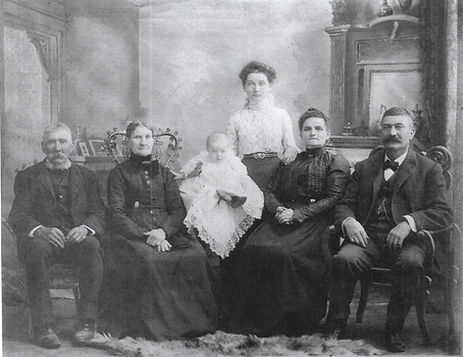
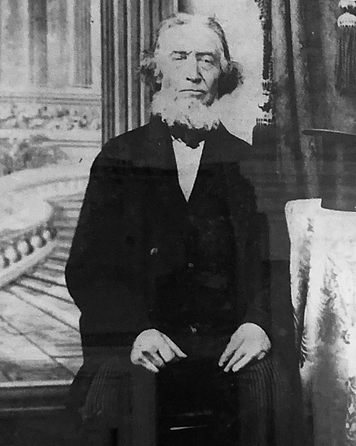
Sebastian Fryfogel, the first European settler in Perth County (1791-1873)
Throughout his years in Perth County, Sebastian made quite the name for himself. He spent a lot of time with others working on the politics and upbringing of the community. He served as District Councillor in 1849, was a Magistrate of long standing, Provisional Warden in 1851, Reeve of South Easthope in 1851, 1853, and 1855-58, was an Assessor from 1851-1853, a Councillor from 1854-1855, and a Collector in 1856.
DESCRIPTION OF SEBASTIAN FRYFOGEL
[excerpt taken from pages 259-260 of History of Perth County]
“On this day one came into Perth County who broke a great silence that from all eternity was unbroken by a note of civilizing voices. This Sebastian was a herald who bore on his own person many of those attributes from which great men and great nations are made. He stood alone in that vast wilderness and planted the standard of an advancing civilization. None saw it unfurled but himself. He could not hear in this distant spot that trampling of feet marching onward to his resting place. Did he dream, I wonder, of those mighty forces he was destined to see, pressing on through this illimitable solitude? Did he think that, from the beginning of all time, it was given to him alone to put forth his hand, saying, all things here shall be transformed? He was a pilgrim pressing on with his banner, on which was inscribed in letters of gold “Excelsior.” He was the forerunner of a new agency, before which that old spirit of the forest would shrink back and flee away, yielding its sway of thousands of years to a new transformation. We are proud to know this Sebastian was a man of strong character, and in this regard typical of many an old pioneer. We quote from a former writer on the subject, who says: ‘It is not necessary to follow his course in detail, as the subsequent history of this district was so marked by his participation in the principal occurrences which go to compose it, that his name appears in almost every connection with it. Suffice it to say, he was a very able and enterprising man, highly respected and implicitly trusted through life, deeply lamented at his death, which occurred at his old home in 1873.’ Those who followed him into the woods honored him with the highest offices in their gift. He was a district councilor, reeve of his township, warden of Perth County, captain in the militia, and one of our oldest magistrates. The whole conduct of this excellent man was honorable to himself and useful to the people who had on so many occasions placed him in positions of trust.”
Peter Fryfogel, Sebastian’s third child and first born son
(1819-1912)
[excerpt taken from Stratford Perth Archives blog - https://www.perthcounty.ca/en/living-here/archives-blog.aspx ]
This week’s treasure is a war medal from the 1800s. Peter Fryfogel of South Easthope Township was given the Canada General Service medal as a member of the New Hamburg Infantry Company during the Fenian raids of 1866. It was donated to our collection in 1973 by Mr. and Mrs. J.C. Martin. Queen Victoria approved this series of medals in 1899 for all those still living who had, among other types of service, been “employed in repelling the Fenian raids on the Canadian frontier.” The silver medal is about one and a half inches in diameter. One side has a portrait of Queen Victoria. The other side has the red ensign flag of Canada surrounded by a wreathe of maple leaves. There is a red and white striped ribbon with a bar that reads Fenian Raid 1866. On the side of the medal, in tiny letters, you can just make out “Sgt. P. Fryfogel, New Hamburg I. Co.”
Peter Fryfogel was born on November 24, 1819 in Pennsylvania. His parents were Sebastian and Mary Fryfogel. They arrived in South Easthope Township (now part of Perth East) around Christmas 1828 to establish the Fryfogel Inn in a log building. It was near the same site, east of Shakespeare, where its brick replacement has stood since the mid-1840s. Peter married Ellen Allen on February 20, 1849. They had 11 children – Amos, Henry, Thomas, Richard, George, Peter A., Anne Jane, Ellen Mary, Sebastian, Elizabeth and Alice.
Fryfogel would have had to apply to the Canadian government via the British War Office in London to be awarded his medal based on events long past. Shortly before his death Fryfogel also applied for a grant under the Fenian Raid Volunteer Bounty Act. On that application, he wrote that he was a Sergeant with the New Hamburg Infantry Company from March 8 to July 5, 1866. To support his claim, he sent in a Comrade’s Declaration form signed by his Company Captain, Kenneth Goodman. Goodman wrote that Fryfogel was “one of the crack shots of the Company – he was a particularly fine man – owned a farm of 200 acres –…It seems hard that there should be a delay in a case like this – it is not the money – it is the recognition of loyal men’s services – he was on active service, including Thorold Camp fully four months…The New Hamburg Infantry Company was the only Company in the County of Waterloo at the time of the Raid in 1866.” In spite of Goodman’s plea to the Military Council in Ottawa to respond quickly due to Fryfogel’s advanced age, the cheque for $100 did not arrive until after Fryfogel’s death from heart failure on July 8, 1912 and was returned to the Militia Department.
Nancy Fryfogel, Sebastian’s seventh child and fourth daughter (1830-1908)
[excerpt taken from page 137 of The Canada Company by
Thelma Coleman]
When Thomas Mercer Jones was a newly-appointed Commissioner in Canada he stayed at the Fryfogel Tavern on one of his tours of inspection. That night a baby girl was born to Mrs. Fryfogel and the new Commissioner gallantly offered the gift of a town lot in Stratford to the little infant when she came of age. In the intimacy of the little log structure, the proprietor’s family and travelers shared the same interior space and the event of a birth was everyone’s joy.
When grown, Nancy Fryfogel came to Stratford to the Canada Company office to see if the agent would honor the promise given at her birth by Thomas Mercer Jones. It was honored and Nancy received a lot located on Albert Street.
Nancy was the first baby to be
born in the newly formed Perth County.

Henry Fryfogel, Sebastian’s tenth child and fifth son
(1836-1842)
The Fryfogel’s tenth child Henry died when he was only 6 years old. His cause of death was recorded as accidental poisoning but stories from family members and psychics have led us to believe that he actually drowned in the brook next to the brick tavern and the family wanted to avoid accusations of not watching their son close enough. To learn more about Henry’s presence at the tavern click here.